

Flat Tyre Auckland? Here’s Exactly What to Do — And Who to Call | Genex Auto
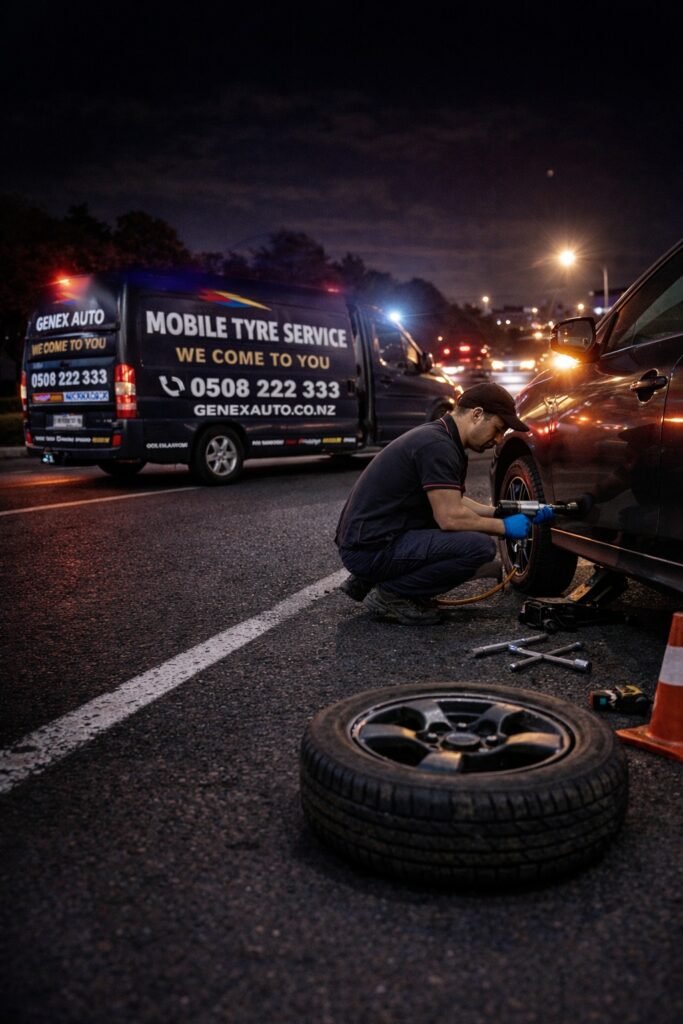
By Genex Auto | Auckland’s 24/7 Emergency Tyre Specialists That Sinking Feeling. Every Auckland Driver Knows It. You’re running on time — school pickup, a work meeting, Saturday morning errands — and then you hear it. That dreaded thump-thump-thump as your steering wheel pulls to one side. Or worse, you walk out to your car and find it sitting lopsided in the driveway before your day has even started. A flat tyre in Auckland is one of those problems that doesn’t care about your schedule. It happens on the Southern Motorway at 7am. It happens in a Manukau car park on a Sunday. It happens at 11pm when every tyre shop in the city is closed and your phone battery is at 12%. This guide covers everything you need to know — what to do when it happens, what NOT to do, and how Genex Auto gets you back on the road fast, anywhere in Auckland, any time of day or night. First Things First — Is Your Tyre Actually Flat? Not every tyre problem is a full blowout. Here are the most common signs Auckland drivers experience: Sudden pulling to one side while driving — your steering wheel tugs sharply left or right. This often means one front tyre has lost pressure rapidly. A rhythmic thumping sound — a flat or very low tyre creates a consistent thud with each rotation. If you hear this, slow down immediately. The car feels sluggish or heavy — a partially deflated rear tyre often goes unnoticed until the handling feels unusually “heavy” or unstable, especially at higher speeds. Your tyre pressure warning light (TPMS) comes on — most vehicles made after 2015 have this system. If the horseshoe-with-exclamation symbol lights up on your dashboard, one or more tyres are significantly low. You walk out and see it — the classic scenario. One corner of your car is sitting noticeably lower than the others. What to Do Immediately — Step by Step If You’re Driving When It Happens Step 1 — Don’t panic and don’t brake hard. Sudden braking on a flat tyre can cause you to lose control. Grip the steering wheel firmly, ease off the accelerator, and let the car slow naturally. Step 2 — Signal and move to safety. Indicate and carefully move to the leftmost lane, then onto the shoulder, a slip road, or a safe area away from moving traffic. On Auckland’s motorways, aim for a motorway ramp or emergency stopping bay. Step 3 — Turn on your hazard lights immediately. This is non-negotiable. Hazard lights should go on the moment you realise there’s an issue — even before you’ve fully stopped. Step 4 — Get out safely — on the passenger side where possible. If you’ve stopped on the left shoulder, exit from the passenger side to avoid stepping into traffic. Keep well clear of the vehicle and the road edge. Step 5 — Call Genex Auto. 📞 0508 222 333 — We’re available 24 hours a day, 7 days a week. Tell us your location and we’ll dispatch a mobile tyre technician directly to you. If You Walk Out to a Flat Tyre at Home or Work This one’s simpler — you’re safe and stationary. Don’t attempt to drive on a flat tyre, even slowly. Driving on a flat, even for a short distance, can destroy the tyre completely, damage your rim, and in some cases damage your vehicle’s suspension. Call Genex Auto and we’ll come to you. Should You Use Your Spare Tyre? If your vehicle has a spare tyre and you’re confident changing it yourself, this can be a temporary solution — but there are some important things to know first. Space-saver spares (the small ‘donut’ spare) are designed for emergency short-distance use only. They typically have a maximum speed of 80km/h and should not be driven on for more than 80–100km. They are not suitable for extended motorway driving. Full-size spare tyres are safer for temporary use but still need to be inspected and properly inflated before you rely on them. No spare at all? Many newer vehicles — including a large number of SUVs sold in New Zealand — no longer come with a spare tyre. They may include a tyre inflation kit (sealant and a compressor), which only works for minor punctures and cannot fix a tyre blowout or sidewall damage. In this case, your best option is calling Genex Auto’s mobile tyre service. Common Causes of Flat Tyres on Auckland Roads Auckland’s roads present a unique set of hazards for tyres. Understanding the common causes can help you reduce your risk. Nails and screws from construction sites — Auckland’s ongoing infrastructure development means construction debris regularly finds its way onto local roads, particularly in growth areas like Flat Bush, Drury, and Papakura. Potholes — Auckland Council roads, especially in older suburban areas, can feature significant potholes. A hard impact can cause sudden pressure loss or, in severe cases, crack the rim. Sharp kerbs and gutters — Catching a kerb at speed, particularly when parking, can cause immediate sidewall damage. Worn tyre tread — Tyres worn beyond the legal 1.5mm minimum tread depth are significantly more vulnerable to punctures and blowouts. Valve stem failure — Sometimes it’s not the tyre at all. The small valve stem where you add air can fail, crack, or get damaged, causing a slow leak. Extreme temperature changes — Auckland’s climate, while relatively mild, still sees temperature swings between seasons that gradually affect tyre pressure over time. Can a Flat Tyre Always Be Repaired? This is one of the most common questions our technicians hear — and the honest answer is: not always. A tyre CAN usually be repaired if: The puncture is in the central tread area (not the shoulder or sidewall) The hole is less than 6mm in diameter The tyre has not been driven on while flat There is no internal structural damage A tyre CANNOT be repaired and needs replacement if: